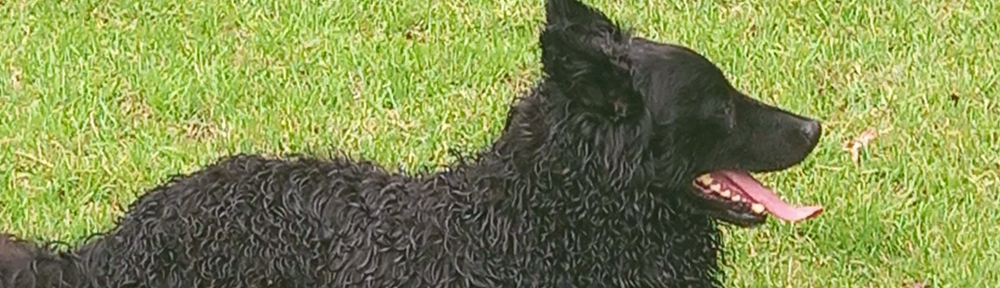
During what was known as the ‘Great Migration’ between the 4th and 6th centuries, many different types of people and dogs arrived on the Great Hungarian Plain. The majority of the dogs were owned by herdsmen, sheepdog who travelled with the flock. There is evidence of Magyar/Hungarians keeping sheepdog from the end of the 9th century, but formal pedigree keeping only came about at the later half of the 19th century. Before this there were only two recognised categories for Hungarian Sheepdogs; Large or Small. Large being the Kuvasz & Komondor, small being the breeds now known today as the Puli, Pumi, and Mudi. More is known and documented regarding Puli and Pumi, Mudi were thought of as the ‘third type’ but it is believed their history is very similar.
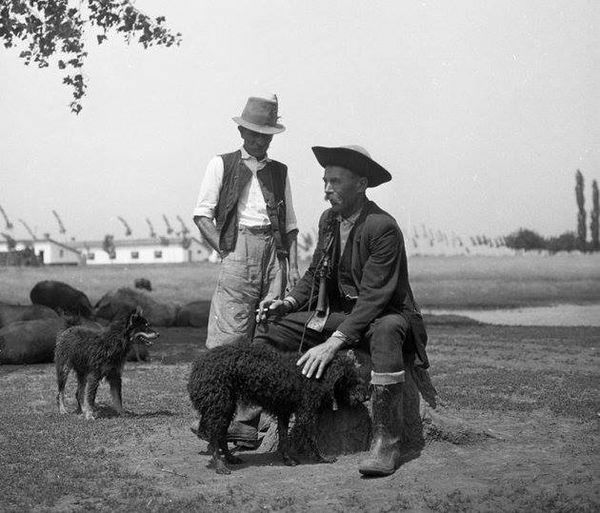
Descriptions of Mudi-type shepherd dogs have appeared in publications from the late 18th century (Buffon, 1773, Ferenc Pethe,1815). Organized breeding of Mudi started around the same time, as were the Pumi and Puli. For a long time, the three breeds were not treated separately. There was also the erroneous belief that the Mudi is a cross between Pumi and Puli, even though it bears no resemblance to either. While “the Puli is Puli”, and Pumi boasts terrier-like ancestors, the Mudi evolved from spitz-like dogs. During his travels across Hungary in the 1930s, Dezső Fényes, museum director of Balassagyarmat, discovered an unnamed breed of a small, curly-coated driving dog with erect ears, high intelligent and docile temperament. Fényes developed this breed further, culminating in the first Mudi standard in Hungary in 1936. Its variety name “Mudi” was probably coined by Mihály Tóth after a shepherd’s dog named Mudi. Prior to that, the breed was simply referred to as a driving dog.
The breed nearly disappeared shortly after its standardisation, when many dogs were killed during World War II. Its resurrection from scratch began again after the War by breeding the few remaining pedigree dogs with B-register specimen. Zoltán Balassy created the modern breed standard, which was accepted in 1963 and added to the FCI Group 1.
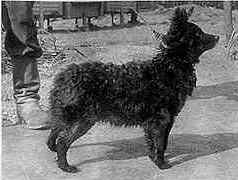
Rigo, the first Mudi registered in Hungary in 1967
Although unknown bloodlines of Mudis are now rare, the B-Register is still open today.
The breed has never been popular, even in its country of Origin. However, those who own a Mudi value their loyalty, intelligence, drive and willingness to please. The original purpose of the breed – the herding of difficult livestock – may no longer be at the centre of their use. Today, Mudis find their purpose in a wide variety of dog sports, especially Herding and Agility as well as Search & Rescue and in Conformation shows. With growing populations in their homeland as well as Scandinavia, the US and across the rest of Europe, the future of the Mudi has never been brighter.
(source: Fényes Mudi Club)
 Mudi Club UK