collated by Thomas Sander
Mudi Coat Colours & Genetics
The Mudi dog breed comes in a variety of appealing coat colours; these colours can occur in solid or merle patterns.
The colours and patterns for a litter will depend on the colours and patterns the breeding pair carries. While black is the only dominant colour, multiple colours can be produced if both parents carry copies of various recessive colour genes. The merle pattern is dominant, and only one parent needs to carry it.
The following Mudi colours are listed in the format of English (US) / Hungarian:
- Black / Fekete
- Black Merle / Cifra
- Brown (Red) / Barna
- Brown Merle (Red Merle) / Barna Cifra
- White / Fehér
- White Merle / Fehér Cifra
- Yellow (Fawn) / Fakó
- Yellow Merle (Fawn Merle) / Fakó Cifra
- Ash (Gray or Blue) / Hamvas
- Ash Merle (Grey Merle) / Hamvas Cifra
- Ashbrown (Greybrown, Isabella) /Hamvasbarna
- Ashbrown Merle (Greybrown Merle, Isabella Merle) / Hamvasbarna Cifra
- Albino / Albinó (Disqualified in standards)
- Double Merle (Disqualified in standards) / Dupla merle
- Other Merle Alleles: Cryptic, Atypical, Harlequin / Ordas színárnyalatok
All the above colours and patterns are accepted in the various breed standards, except for Albino and Double Merle, which is a disqualification. Minimal white markings on the chest and toes are acceptable, but not desirable, when following breed standards.
Dark brown is the preferred eye colour in a Mudi; yellow eyes depending on the parent club, will be disqualified or receive low marks from judges.
In the articles below, we will examine each colour one by one.

The black Mudi

Black is, arguably, the most common colouration of Mudi. A small spot of white is permitted on the chest or toes, but not desired; in breeding, a white spot with a diameter smaller than 5 cm is allowed.
Black is a dominant colour gene located on the K locus for the distribution of pigments and a recessive gene on other loci.
The lip and eye pigmentation will be black genetically.
Black may also hide Sable and Tan Points patterns.
Black dogs can produce brown offspring only if they carry a copy of the recessive brown and are bred with a dog who also carries at least one copy of brown.
The black merle Mudi

The black merle is striking and unique, it’s considered the most common merle colour.
These dogs are genetically black with a merle pattern. The merle patches can be various shades along the black colour range; the merle is a dominant gene and cannot be “carried” by a non-merle dog, though it can be “masked” by some genes.
It is best known in the blue-merle colour, which is on a blue-grey base, spotted, striped, and marbled with black. They are dark grey or black pigmented, preferably with dark brown eyes. It may happen, especially if the head is speckled with small spots, that one or both eyes are blue. In some cases, they have double-sided eyes, or the iris of the eye has a blue stripe or star on a brown background, or maybe half blue and half brown. It’s not a mistake. Of course, dark eye colour is desirable.
You should know about them, that this colour variant also darkens with age. While the black marbling appears on a light grey base at a young age, at the age of 4-6 the base colour is much darker. We are more lenient with white markings on the breast and ends of the legs, but extensive, white markings are not allowed here either. At birth, they can see the light of day with a large white chest spot and white legs, but this starts to become speckled at the age of a few weeks. It almost or completely disappears in adulthood.
Merle dogs should not be bred together, as homozygous merle dogs are prone to pigment-related health problems.
The brown Mudi
Its colour range can range from light milk chocolate (light chestnut shade) to really dark brown. Here, too, the shades are determined by the lightening genes. Its colour is caused by the “b” gene, which dilutes black to brown, in the same way as in ash, black is diluted to brown in the “bb” pair.
Their eyes are yellowish brown, ideally reminiscent of the medium brown eye colour of blacks. Its pigment harmonizes with the colour of the hair and eyes, so the nose and lip pigmentation will be brown genetically.
Brown is a recessive colour; two brown dogs cannot produce a genetically black dog.
The brown merle Mudi
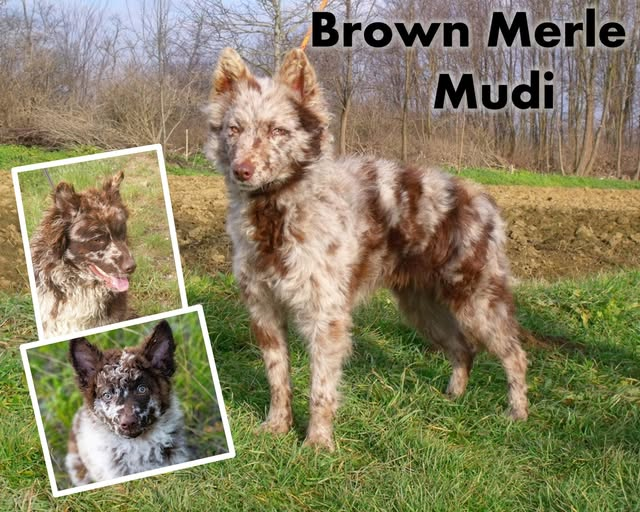
The brown merle Mudi is genetically brown, with a merle pattern. The merle patches can be various shades along the brown colour range, from a pale chestnut to deep liver, with spots anywhere along the spectrum of brown.
The occasional appearance of the brown merle colour from parents of other colours only depends on whether both parents are of the Bb genotype, i.e., brown carriers or not (BB). In addition, of course, it is also necessary that one of the parents is a merle.
If someone wants a brown merle Mudi, mating a brown with a brown merle would give you the best chance of getting brown merle pup. In this case, the offspring can only be brown and brown merle.
The brown merle has become very popular in Hungary in recent years, although it is not often seen in the UK. With its various shades of brown, brown nose and possibility of lighter eye colours, it makes its appearance magical.
The Ash Mudi
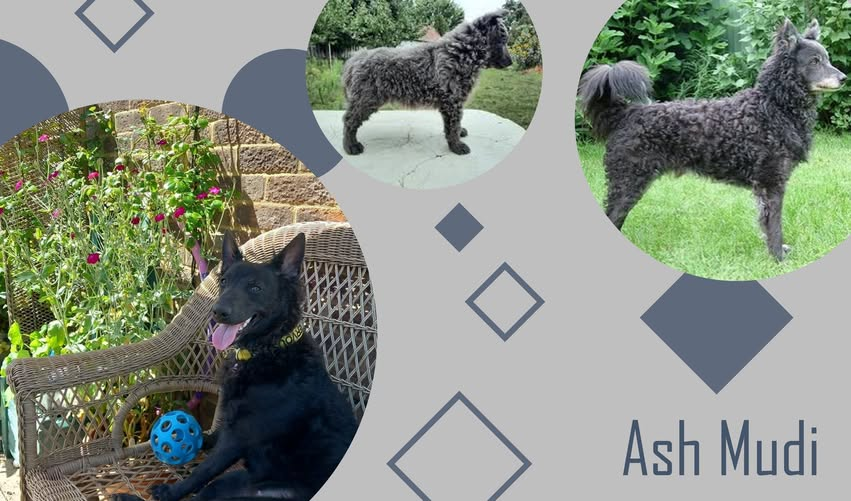
Ash – also called blue in some breeds – is the result of a black dog with two copies of the recessive dilution gene. The dog appears steel-grey in colour, and is identified visually by nose leather colour, which will be a bluish grey as opposed to black.
Ash colours may range from a light silver shade to a darker charcoal shade. The lighter shade of childhood darkens later.
The colour of their eyes is also made lighter by the present “dd” gene pair. Ash colour with dark brown eyes is still very rare in the breed, but dark eye colour is the goal for this colour variant as well.
Unfortunately, dilute colours in some breeds also correlate with a skin disorder called “colour dilution alopecia” or CDA. Some Mudi do suffer from CDA, with mild to severe side effects, and currently there is no genetic test available to identify the cause of CDA.
With the ash-coloured version, there can be big differences in the quality of the coat, and bald ears are not uncommon.
The Yellow Mudi
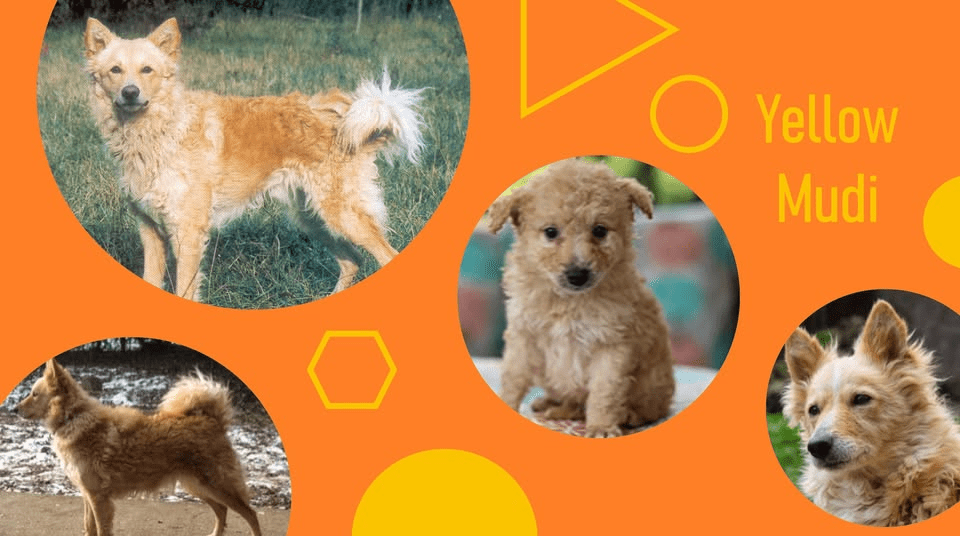
Yellow (Hungarian: Fakó, Aranyfakó) is a recessive gene, so two yellow or yellow-carrying parents are required for yellow offspring. “Yellow” can actually range in shade from pale cream to deep orange or darker fox red shade. Some Mudi are so pale they are considered white, though still caused by the same gene.
Yellow “dominates” all other colour and pattern loci. A yellow dog will still be black or brown genetically and will display black or brown nose leather accordingly, it is the same with the lip and eye pigmentation.
The yellow dogs are born yellow. Pigmentation is rarely apparent when born, sometimes there is slight grey coloration in the edge of the mouth. By the time they mature, their colour darkens and the pigment becomes black. During winter season the colour of their nose can change. When turning old, the nose pigmentation may lighten out.
Additionally, yellow can hide other patterns, like merle – meaning that a dog could be yellow and merle and look non-merle in appearance. Genetic colour testing is critical in these situations to avoid pairing merles.
The White Mudi
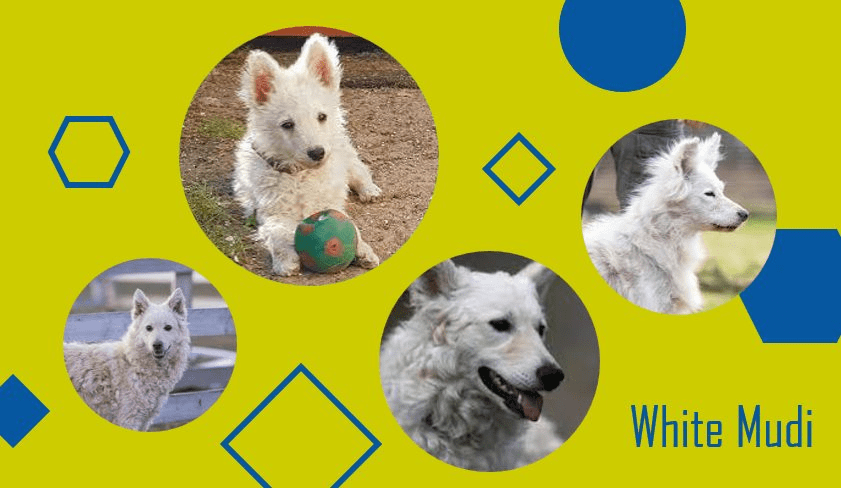
The white Mudi is commonly white as snow when born, but slight variations from the original are possible within a litter.
Normally, they are born with pink nose, without any pigmentation. The pigment spots start appearing in 1-2 days after birth. Sometimes rose-greyish colouration may be seen on their nose, on the edge of the mouth, or on the inside of the ears when born.
They have dark brown eyes. As they get older, especially during winter, the white colour may turn into shades of yellow on the ears and along the spine.
The change of nose colour is common. These characters are mainly due to the lack of sunshine, but the hormone system also contributes to them.
Still to come:
The Ash-Merle Mudi
The Ash-Brown Mudi
The Ash-Brown-Merle Mudi
The Yellow-Merle Mudi
 Mudi Club UK